Mid-Season Energy Market Update – July 2025
John Palmer
Director of Flexible Procurement
John Dawson
Energy Trader & Market Intelligence Manager


At a glance, energy prices appear stable, but beneath the surface, volatility is alive and well – and moving fast.
From the Gaza conflict to shifting EU storage targets, the first half of 2025 has shown just how quickly the market can swing: price corrections have been sharp, speculators have pulled back, and yet, near-term risk remains stubbornly high.
If energy is a major cost line for your business, this is no time for passive procurement.
The second half of the year presents both opportunity and threat, and the right trading strategy will determine which you experience…
As we move deeper into Q3, wholesale energy markets appear to be drifting sideways – a welcome reprieve on the surface. Volatility, however, is never far from view. From speculative trading shifts to evolving EU policy and LNG redirection, the market remains reactive, unstable, and quick to correct.
In this mid-season update, we revisit the key takeaways from our Summer Outlook webinar, explore what has happened since, and consider how the second half of 2025 might unfold.
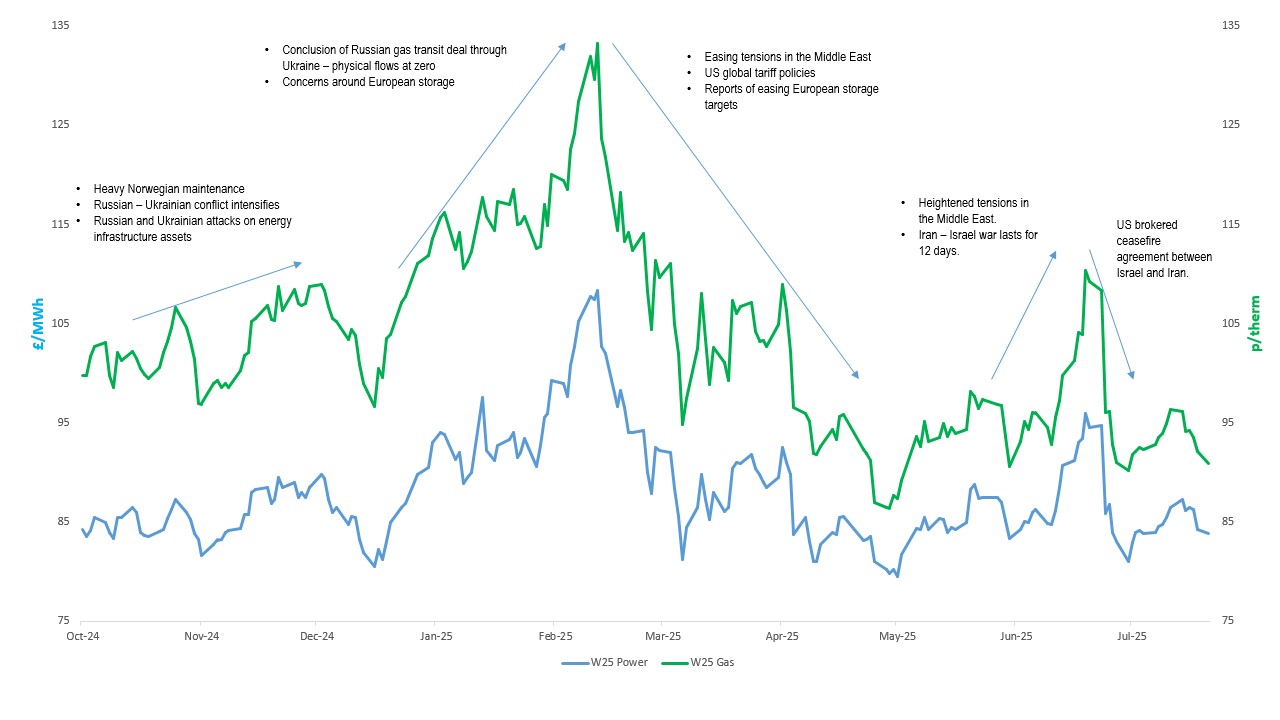
In late 2024 and early 2025, bullish momentum built across European gas markets as geopolitical tension escalated in the Middle East, particularly in relation to the conflict in Gaza. Unplanned outages at Norwegian gas facilities added pressure, while Russia’s Gazprom confirmed that it would end gas deliveries to Austria’s OMV, with flows terminating by the end of December 2024.
Following the previous winter, EU gas storage was sitting at historically strong levels – a result of robust injection programmes and lower-than-expected industrial demand in late 2024. However, those levels masked underlying concerns. Storage had not been replenished over the Christmas period, and withdrawals during January and February outpaced those of the two prior winters. While some procurement teams remained confident in the system’s overall resilience, others saw early signs of imbalance creeping back into the market.
By late March, weather remained colder than expected, but the market had already begun to soften. Prices were drifting lower as hedge funds unwound long positions — a sell-off that had started in the second half of February. Forward sentiment was further pressured by the announcement of US tariffs on LNG to China, adding another layer of complexity to global supply dynamics. In this context, European reliance on stored gas became more visible, even as near-term pricing eased.
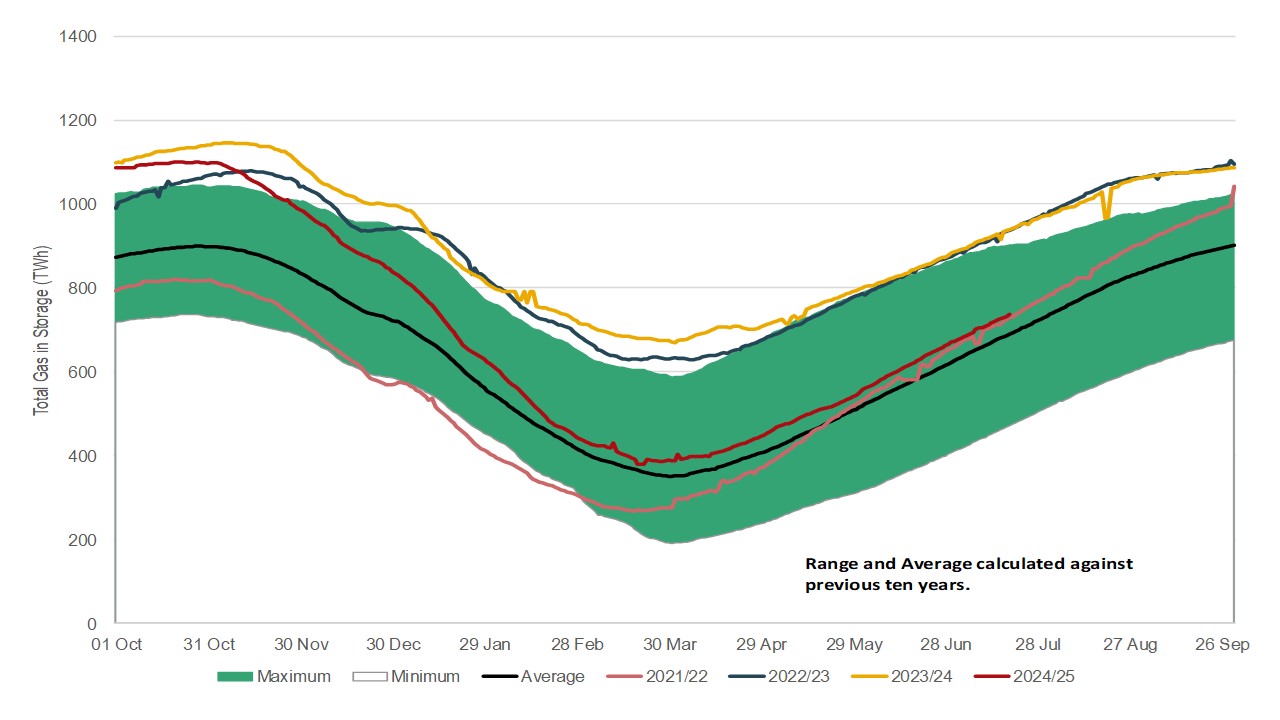
As discussed in our Summer Outlook webinar, the EU’s 90% gas storage mandate – supported by interim injection targets – played a defining role in shaping trading sentiment through late Q4 2024 and into Q1 2025. The prevailing assumption was that these thresholds would be met regardless of cost, pushing up Summer-25 gas contracts as traders priced in future demand driven more by compliance than consumption.
However, even as this bullish narrative took hold, doubts had already begun to surface. During Q1, policymakers across several member states signalled discomfort with the rigidity of the targets – citing exceptional weather conditions, unseasonably high withdrawal rates, and “technical issues” that were hampering injection schedules. Market participants took note. The hedge fund sell-off in February and softening prices by late March reflected a growing awareness that the original targets might not hold.
Clarity finally arrived in May, when targets were amended to allow for reduced injection obligations under specific conditions. That confirmation triggered a sharper price correction, accelerating the trend that had already begun. In mid-June an escalation of the Israel-Iran conflict saw prices spike, before retracing gains. It followed the pattern we outlined during the webinar: bullish positioning fuelled by policy and geopolitical events, followed by a correction as fundamentals reasserted their influence.
Further dampening prices was the knock-on effect of US tariffs on LNG to China, which redirected shipments back to European buyers, easing immediate supply concerns and increasing short-term availability.
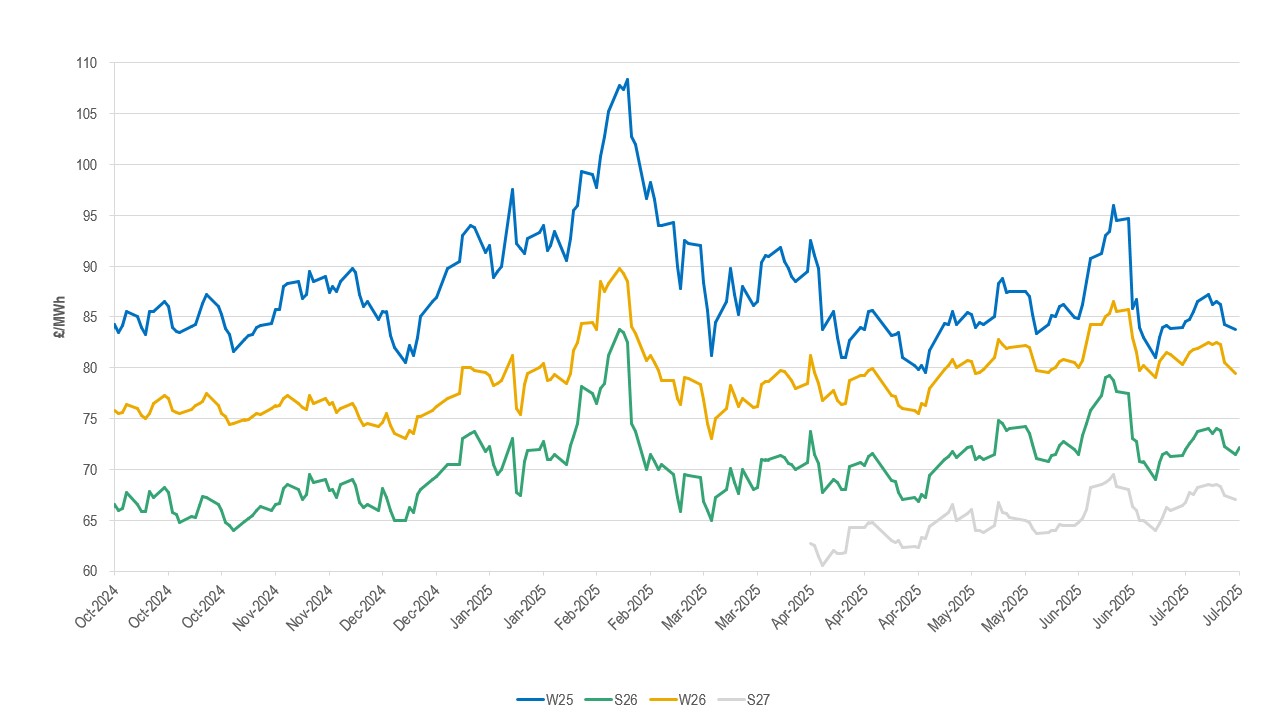
Despite price cooling, the market remains extremely sensitive to geopolitical developments.
The Russia–Ukraine pipeline route is now inactive following the expiration of key transit agreements at the end of 2024. A brief détente (spurred by Trump-led negotiations) offered momentary relief, but Europe’s long-term gas transit infrastructure remains fundamentally compromised. Nord Stream is still offline, and hopes for resumed Russian flows into Europe are tempered by contractual complexity, legal restrictions, and policy intent. Adding to this uncertainty is the recent announcement warning of renewed sanctions unless Russia agrees to a ceasefire. While lacking executive authority, the statement has reintroduced political volatility into a market already skittish about global risk.
Tensions in the Middle East, particularly around Gaza and the Strait of Hormuz, continue to unsettle the market. While physical supply has held up, risk premiums remain embedded, particularly for LNG deliveries. Together, these factors keep geopolitical risk front and centre even as prices cool.
Meanwhile, speculative capital continues to shape short-term pricing. After building up significant long positions in January (anticipating stronger winter demand) many funds rapidly reduced their exposure in February and March as price signals turned bearish. By late July, net long positions had fallen to their lowest levels since the same period in 2024. The pace and volume of these shifts suggest that sentiment, rather than fundamentals, remains the primary driver of volatility.
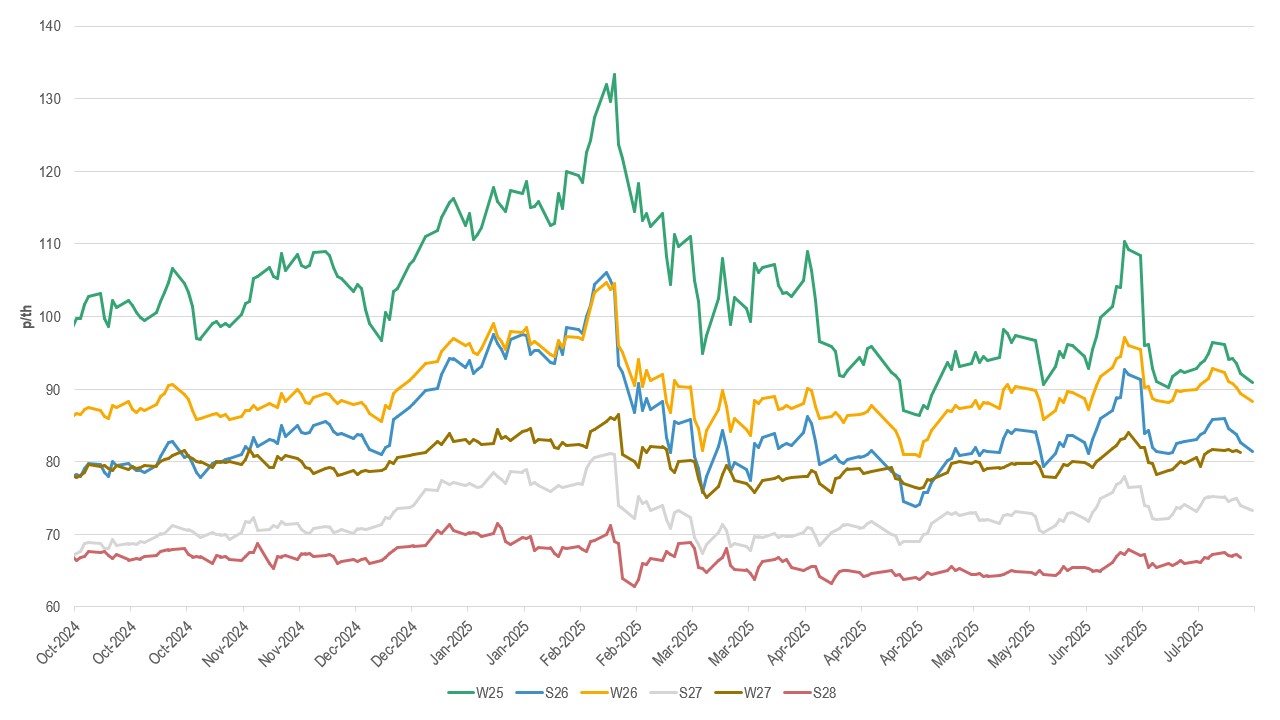
Gas and power markets remain in backwardation, with contracts for Winter-25 still trading at a premium to later periods, although the premium appears to be eroding. This suggests traders are pricing in near-term uncertainty, despite softer headline prices.
Recent downward pressure reflects confidence that EU storage will exceed 90% by October – a reassuring milestone – but longer-term, storage remains a structural concern, particularly as Europe grows more reliant on LNG.
Contributing factors include:
Even in quieter months, risk premiums remain a defining feature of the curve.
As we begin to prepare for our Winter 2025 Outlook, the following developments will be key:
The market may appear calm, but the underlying drivers remain as volatile and unpredictable as ever. From shifting EU policies to LNG redirection and geopolitics, 2025 continues to demand focus, flexibility, and fast decision-making.
Here is what matters most:
In short, the second half of 2025 will reward those who stay sharp, stay agile, and stay informed. If your strategy isn’t evolving with the market, it’s already falling behind.
The energy markets won’t wait, and neither should your strategy.
Get ahead with a free, no-obligation strategy workshop tailored to your objectives, risk appetite, and budget constraints. We’ll pressure-test your current approach, highlight emerging opportunities, and build a roadmap that responds to real-world volatility (not outdated assumptions).
With £37.5 million in procurement savings delivered since 2024 and over 6.7TWh in utilities under management, we know how to make complex portfolios deliver value. Whether you’re locking in ahead of winter or reviewing your long-term position, we’ll help you trade with confidence.

With a century of combined experience in carbon and energy strategy, EIC Partnership is here to help you manage today and plan for tomorrow.
Head Office
Monarch House
7-9 Stafford Road
Wallington
SM6 9AN
Redditch
3 Brooklands
Moons Moat Drive
Redditch
B98 9DW
EIC Partnership is the trading name for:
Energy Intelligence Centre Limited
Registered Number: 11899462 | Registered Address: 7-9 Stafford Road, Wallington, SM6 9AN | VAT Registration: 318 2851 01
ESS (Utility Consultants) Limited
Registered Number: 06585789 | Registered Address: 7-9 Stafford Road, Wallington, SM6 9AN | VAT Registration: 679 9865 35
The Monarch Partnership Limited
Registered Number: 04346309 | Registered Address: 7-9 Stafford Road, Wallington, SM6 9AN | VAT Registration: 793 6132 10)
