Non-Commodity Costs Update
Ashley Game
Insight Analyst


The National Energy System Operator (NESO) has confirmed the BSUoS price from October 2025 to March 2026 will increase from £10.74/MWh to £15.69/MWh due to a rise in constraint costs. NESO has also published its latest draft tariffs for 2026/27, which are £14.21/MWh for April 2026 to September 2026 and £11.93/MWh for October 2026 to March 2027. These tariffs will be confirmed in December 2025.
New nuclear is set to be funded by a RAB model, similar to CfD. A RAB model has been used previously in the UK to finance large scale infrastructure assets such as water, gas and electricity networks. The nuclear RAB model will differ from the CfD scheme as consumers will start to pay a regulated price once construction starts instead of when generation starts to avoid the build-up of interest on loans that would ultimately lead to higher costs.
Following the approval of Sizewell C, it has been confirmed that nuclear RAB charges will start in December 2025 at an initial rate of £3.540/MWh. This charge is higher than previously forecast as the estimated cost of building and financing Sizewell C has increased. The Interim Levy Rate will change each quarter and be confirmed by LCCC one month in advance. There will also be a small Operational Costs Levy of £0.0028/MWh starting in October 2025.
NESO has recently published its latest 5-year TNUoS forecasts from April 2026, which coincides with the start of the new TNUoS price control period (RIIO-3). Ahead of RIIO-3, Transmission Operators have submitted their business plans to Ofgem with increased costs required to cover the installation of several major transmission projects.
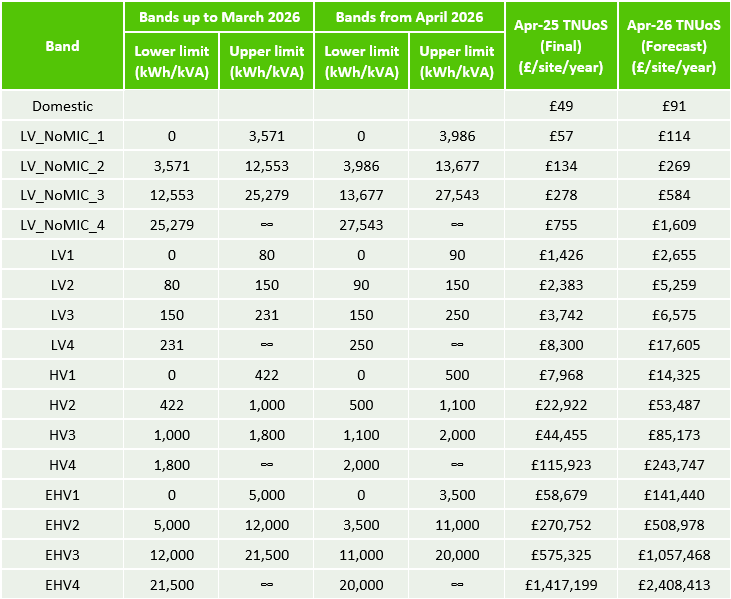
Ofgem’s draft determinations have been used by NESO in its 5-year forecast and, as a result, fixed TNUoS costs are set to increase considerably from April 2026. The forecast figures in the table below show that TNUoS costs are currently expected to increase by an average of 90% in April 2026 for HH sites. Ofgem will confirm final determinations by the end of the year with final TNUoS tariffs published by the end of January 2026.
The charging band boundaries that apply to both DUoS and TNUoS tariffs have now been fixed from April 2026 to March 2031. The charging band a site is placed in will be decided by the average capacity or consumption between May 2022 and April 2024. There has been a slight shift in boundaries so some sites will move charging bands from April 2026.

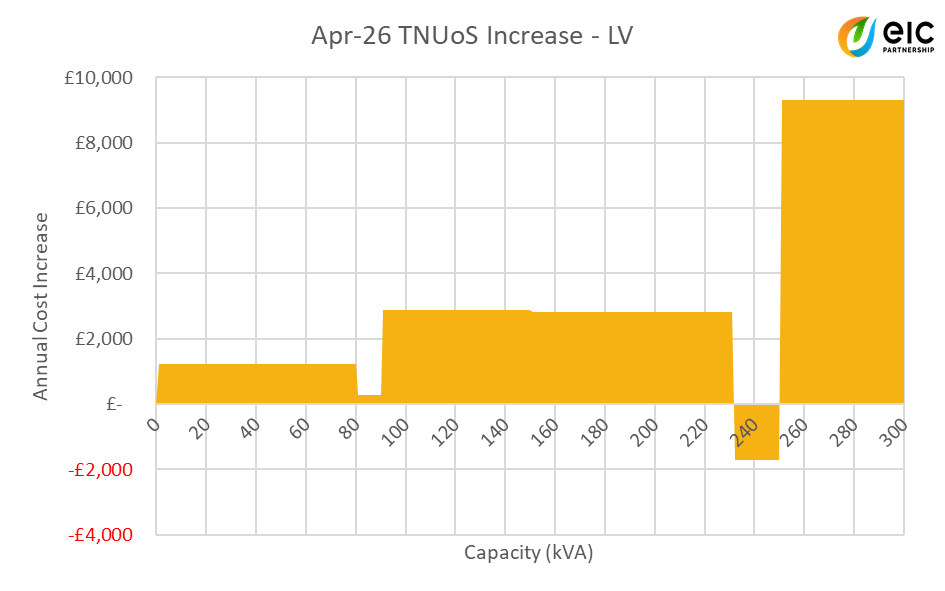
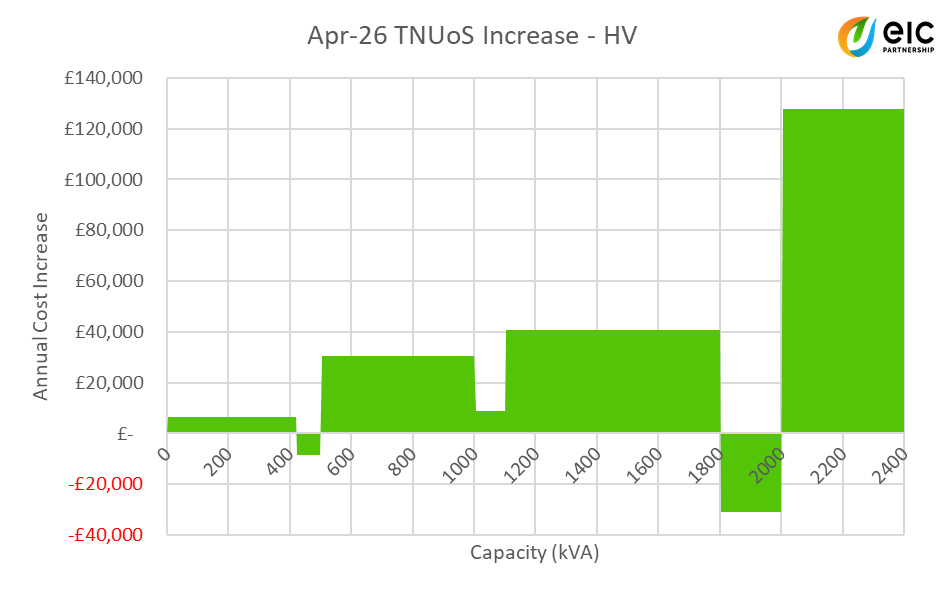
The graphs below show that for a small number of sites there will be a reduction in TNUoS costs from April 2026. Low voltage sites with a capacity between 232kVA and 250kVA will move from LV band 4 to LV band 3 and see their annual TNUoS costs fall by £1,725. High voltage sites with capacities from 423kVA to 500kVA and from 1,801kVA to 2,000kVA will also move down a band and save £8,597 and £30,750 a year, respectively.
On the other hand, the boundaries for extra high voltage sites have moved in the other direction so a small number of EHV sites will move into higher charging bands. According to data from NESO, this will apply to around 50-60 EHV sites that will see TNUoS costs increasing by 4 to 8 times. In the most extreme case, EHV sites with a capacity between 3,501kVA and 5,000kVA will go from paying £58,679 to £508,978 a year.
The increase in costs from April 2026 will see the average TNUoS rate rise from £15.72/MWh to £30.50/MWh with the proportion of electricity costs made up by TNUoS increasing from 7.7% to 13.2% for an average HH consumer. However, in the EHV case described above TNUoS costs could rise to £50-60/MWh, making up to 25% of the total electricity bill.
Capacity market charges are also expected to increase by around 90% from April 2026 as the T-4 auction for delivery year 2026/27 saw clearing prices increase from £30.59/kW to £63/kW. CM costs are forecast to remain high in 2027/28 and 2028/29 before falling slightly in 2029/30 as the T-4 auction target capacity has decreased from 43.1GW to 39.1GW.
Suppliers typically invoice capacity market charges based on winter peak consumption, which covers 4pm-7pm on weekdays between November and February. As a result CM levy rates are much higher than other non-commodity rates as they only apply to around 4% of national annual demand. CM levy rates are forecast to increase from £140-150/MWh in 2025/26 to £270-280/MWh in 2026/27.
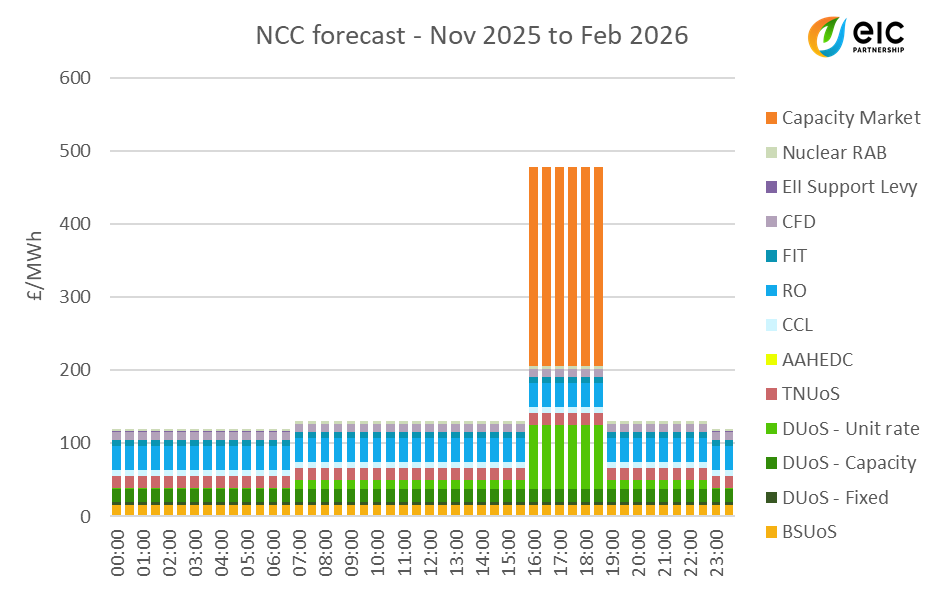
With DUoS red band unit rates currently averaging around £90/MWh, there is now even more incentive to reduce evening peak demand during winter months. The graph below shows how non-commodity costs are expected to vary across an average winter weekday in 2025/26 for a low voltage site.
Next year’s CM costs will be based on this winter’s evening peak usage so total non-commodity costs during this period are forecast to be around four times higher at nearly £500/MWh. As a result, reducing demand between 4pm and 7pm on weekdays this winter could result in significant cost savings going forward.
EIC Partnership can help you accurately budget and forecast your energy prices with confidence with our Long-Term Forecast Report (LTFR). The LTFR is a valuable tool which illustrates the annual projected changes to your energy bills and calculates your energy spend over the next 5, 10, 15 or 20 years. This allows you to confidently forward budget and avoid any nasty surprises. Whilst we can’t prevent the rise of non-commodity charges, we can ensure you are fully prepared for the increases.
It is also important to check that all of your HH sites have the correct capacity level to ensure you are not overpaying on DUoS and TNUoS charges. While the charging bands have been set for the next five years, the assessment period for the next price control (RIIO-4) will begin in 2027 so we recommend reviewing your capacity levels before then. In the short term, this can result in savings on DUoS capacity costs, however it may also lead to lower fixed DUoS and TNUoS costs in the future if moving to a lower charging band.
EIC Partnership can undertake detailed analysis for each of your sites, outline potential savings and offer clear advice on what action you should take. If we find that your capacity can be reduced by more than 50% it may also be possible to apply for an immediate charging band reallocation which could significantly cut your DUoS and TNUoS charges.

With a century of combined experience in carbon and energy strategy, EIC Partnership is here to help you manage today and plan for tomorrow.
Head Office
Monarch House
7-9 Stafford Road
Wallington
SM6 9AN
Redditch
3 Brooklands
Moons Moat Drive
Redditch
B98 9DW
EIC Partnership is the trading name for:
Energy Intelligence Centre Limited
Registered Number: 11899462 | Registered Address: 7-9 Stafford Road, Wallington, SM6 9AN | VAT Registration: 318 2851 01
ESS (Utility Consultants) Limited
Registered Number: 06585789 | Registered Address: 7-9 Stafford Road, Wallington, SM6 9AN | VAT Registration: 679 9865 35
The Monarch Partnership Limited
Registered Number: 04346309 | Registered Address: 7-9 Stafford Road, Wallington, SM6 9AN | VAT Registration: 793 6132 10)
